
Insects & Creepy-Crawlies
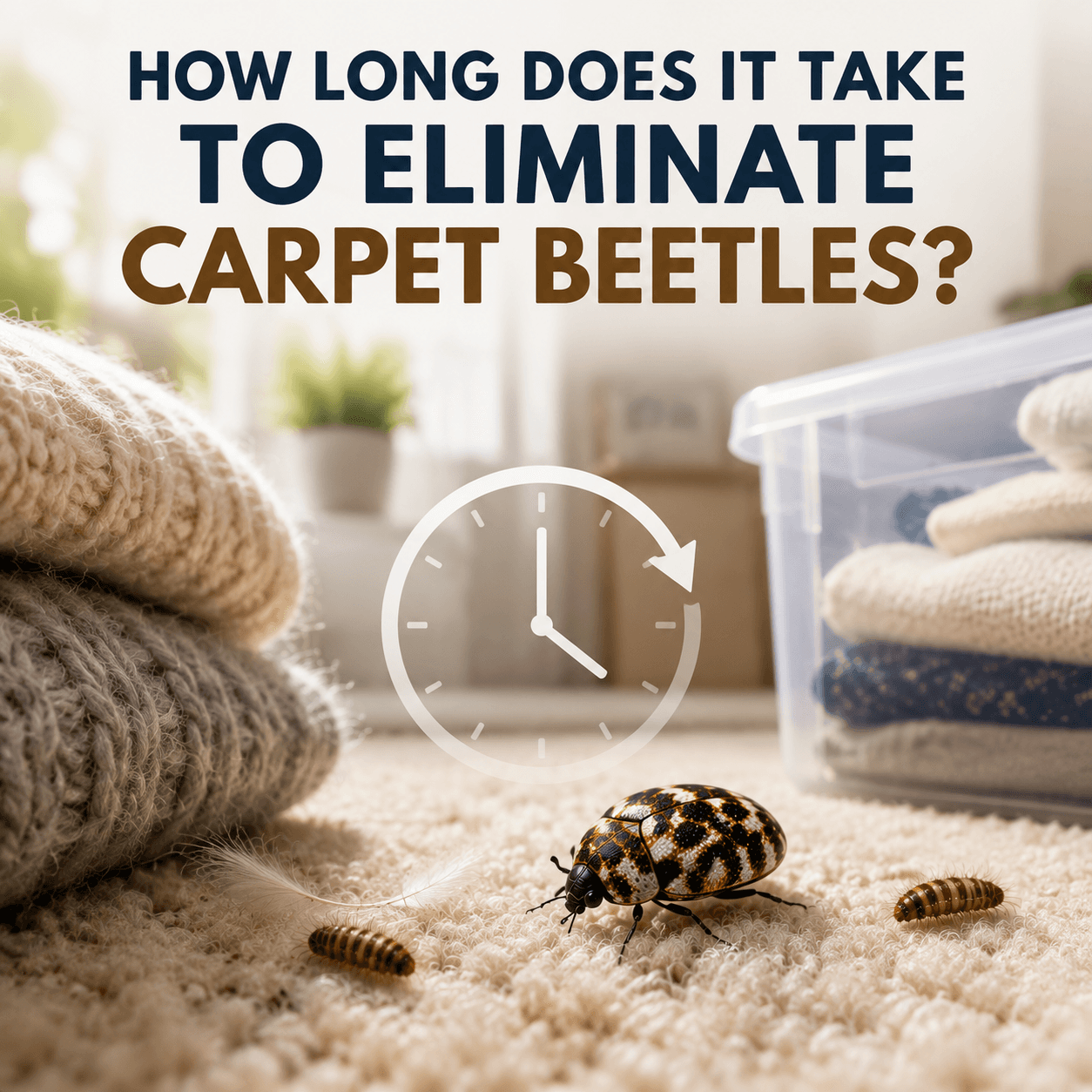
How Long Does It Take to Eliminate Carpet Beetles?
Small infestations may improve within weeks, while larger problems can require months of consistent effort.
You’ve vacuumed your carpets, washed your clothes, cleaned your closets, and finally feel like you’ve handled the problem.
But then, a few days later, you notice another small beetle near the window.
Or you find another larva hiding in a corner.
Immediately, you start wondering:
“Is the treatment not working? How long does it actually take to get rid of carpet beetles?”
The frustrating truth is that carpet beetle elimination is rarely an instant process.
Unlike pests that are easily visible, carpet beetles often hide in areas homeowners don’t regularly check. Eggs, larvae, and hidden food sources can allow the infestation to continue even after the visible signs decrease.
In this guide, we’ll explain how long carpet beetles typically take to eliminate, what affects the timeline, and what steps can help speed up the process.
🏠 Introduction: Why Carpet Beetle Removal Takes Time
One of the biggest misconceptions about carpet beetles is expecting them to disappear immediately after cleaning or treatment.
However, eliminating carpet beetles requires addressing multiple stages of their life cycle:
- Eggs
- Larvae
- Adult beetles
The adults you see are often only part of the problem.
The larvae are usually responsible for the damage and may remain hidden in:
- Closets
- Rugs
- Storage areas
- Under furniture
- Baseboards
This is why complete elimination often requires patience and consistency.
🐞 Understanding the Carpet Beetle Life Cycle
To understand the timeline, it helps to understand how carpet beetles develop.
Eggs
Female carpet beetles lay eggs near food sources.
These eggs are difficult to notice because they are extremely small.
Larvae
The larval stage is the most damaging.
During this stage, they feed on:
- Wool
- Silk
- Fur
- Feathers
- Pet hair
- Organic debris
Larvae can remain hidden for months depending on conditions.
Adult Beetles
Adult carpet beetles are often noticed near:
- Windows
- Curtains
- Light sources
They are usually less damaging than larvae but indicate that the infestation may still be active.
⏳ How Long Does It Usually Take to Get Rid of Carpet Beetles?
The timeline depends on how severe the infestation is.
Small Infestations
For minor problems:
Several weeks may be enough
if homeowners:
- Remove food sources
- Clean thoroughly
- Treat affected areas
- Monitor activity
Moderate Infestations
For larger infestations:
One to several months may be required
because:
- Eggs may continue hatching
- Larvae may be hidden
- Multiple areas may need attention
Severe Infestations
For widespread problems:
Several months or longer may be needed
especially when carpet beetles are found in:
- Multiple rooms
- Stored belongings
- Large carpeted areas
🔍 Factors That Affect Elimination Time
Several factors determine how quickly carpet beetles disappear.
1. Size of the Infestation
A small number of beetles is much easier to control than an established population.
The longer carpet beetles have been present, the more hiding locations they may have.
2. Number of Hidden Areas
Carpet beetles often survive because homeowners miss areas such as:
- Behind furniture
- Inside closets
- Under carpets
- Storage containers
Hidden larvae can restart the problem.
3. Available Food Sources
If larvae still have access to:
- Pet hair
- Dust
- Natural fibers
- Forgotten fabrics
they can continue developing.
4. Cleaning and Treatment Consistency
One deep cleaning session may help, but regular follow-up is usually necessary.
Consistency matters because new larvae may appear after eggs hatch.
5. Entry Points From Outside
Adult carpet beetles can enter homes through:
- Open windows
- Door gaps
- Cracks around the exterior
New beetles entering from outside can extend the problem.
🔄 Why You May Still See Carpet Beetles After Treatment
Seeing carpet beetles after starting treatment does not always mean failure.
Possible reasons include:
Eggs Are Still Hatching
Cleaning may remove many larvae, but eggs already present may continue developing.
Hidden Larvae Were Missed
Some larvae survive in areas that are difficult to reach.
Adult Beetles Are Entering From Outside
Outdoor populations can continue to introduce new beetles.
The Food Source Remains
If larvae still have access to materials they can eat, the infestation may continue.
⚡ Steps to Speed Up Carpet Beetle Removal
✔ Vacuum Frequently
Focus on:
- Carpet edges
- Baseboards
- Closet floors
- Furniture gaps
Regular vacuuming removes larvae and potential food sources.
✔ Wash and Inspect Fabrics
Pay attention to:
- Clothing
- Blankets
- Rugs
- Stored materials
✔ Clean Hidden Areas
Do not overlook:
- Under furniture
- Storage rooms
- Attics
- Basements
✔ Store Fabrics Properly
Use:
- Sealed containers
- Clean storage bags
especially for seasonal clothing.
✔ Monitor Activity
Continue checking for:
- Larvae
- Shed skins
- Fabric damage
Monitoring helps confirm whether the infestation is decreasing.
👨🔧 When to Consider Professional Help
Professional assistance may be worth considering when:
- The infestation continues for months
- Fabric damage keeps appearing
- Multiple areas are affected
- DIY methods have not worked
A professional inspection can help identify hidden sources that are easy to overlook.
⚠️ Common Mistakes That Slow Down Removal
Treating Only Visible Bugs
The insects you see are usually not the whole problem.
Ignoring Storage Areas
Closets and stored fabrics are common hiding places.
Stopping Treatment Too Early
Reduced activity does not always mean complete elimination.
Forgetting Prevention
Without addressing entry points and attractants, carpet beetles can return.
💡 Conclusion: Consistency Is the Key to Long-Term Control
So, how long does it take to eliminate carpet beetles?
The answer depends on how large the infestation is and how thoroughly the problem is addressed.
Small infestations may improve within weeks, while larger problems can require months of consistent effort.
The most important thing is understanding that carpet beetle control is not just about removing the insects you see.
It’s about breaking the entire cycle:
- Removing food sources
- Eliminating hidden larvae
- Preventing new infestations
Because with carpet beetles, patience and consistency are often what make the biggest difference.